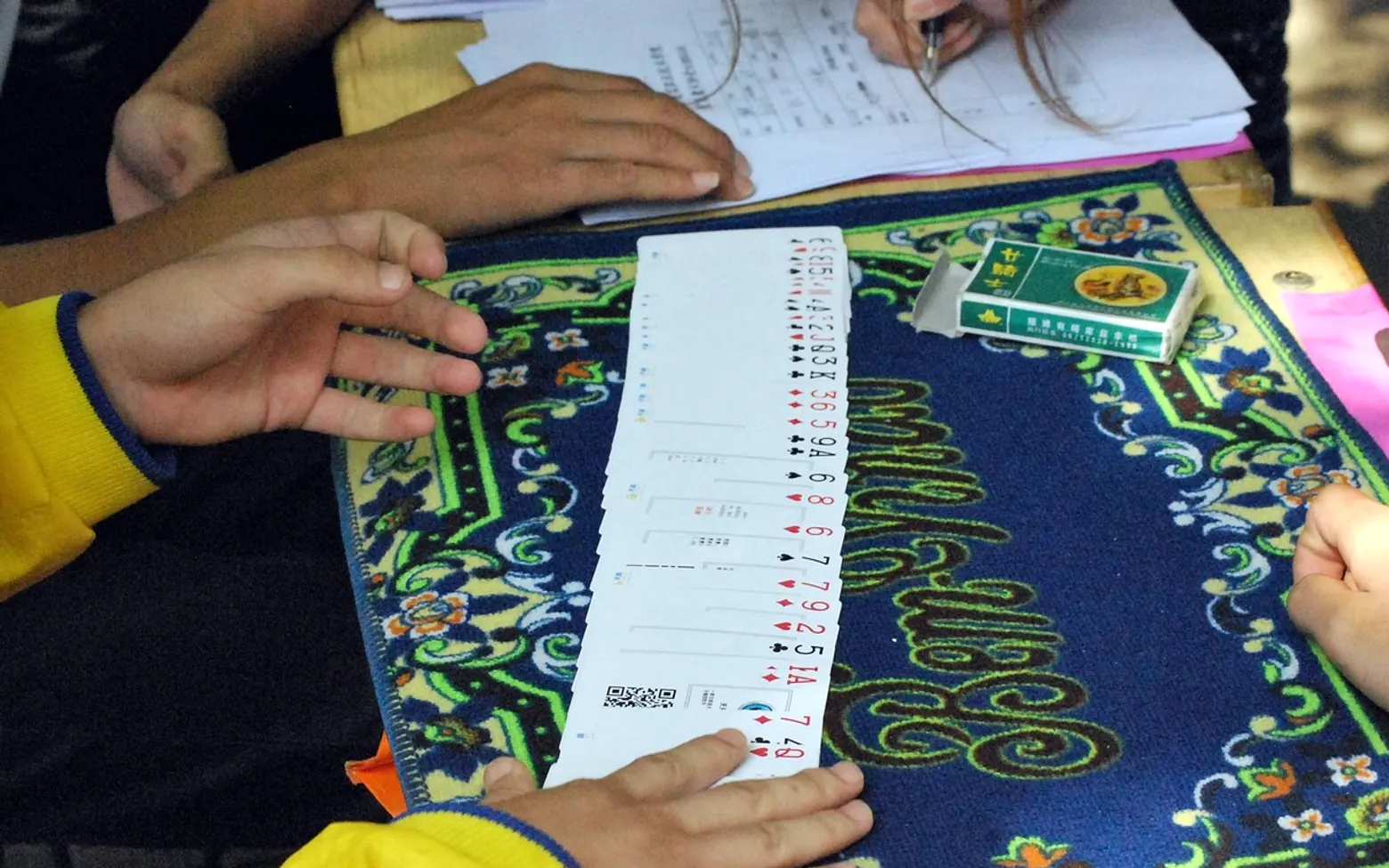
Short deck poker is Texas Hold'em played with a 36-card deck: every two, three, four and five is removed, leaving the sixes through the aces. Each player still gets two hole cards and shares five community cards, but the smaller deck changes how often each hand appears, and so the hand rankings change too. The best-known change: a flush beats a full house. In many rule sets, three of a kind also beats a straight.
The game is also called six-plus Hold'em, after its lowest card. It spread through high-stakes live games in the 2010s and is now dealt in some online rooms and home games. Here are the rules, the changed rankings and the counting behind them.
The rules of a hand
The structure follows Hold'em closely:
- Forced bets. Some games use the usual small and big blinds. Many use an ante from every player instead, sometimes with an extra ante or blind posted by the player on the button. The table's listing says which.
- The deal. Each player receives two private cards.
- Betting rounds. Pre-flop, flop (three community cards), turn and river, with a round of betting after each, exactly as in Hold'em.
- Showdown. Each remaining player makes the best five-card hand from their two cards and the five on the board. Unlike Omaha, any combination is allowed, including playing the board.
Most games are played no-limit, so the whole stack can go in at any time. The difference between that and capped betting is set out in our comparison of pot-limit and no-limit poker.
The ace still plays low
With no fives in the deck, the lowest straight is A-6-7-8-9: the ace jumps the gap and acts as the card below the six. The highest is still ten to ace. That gives six possible straights in place of the usual ten, a detail that matters for the counting below.
Short deck hand rankings
| Rank | Short deck | Standard Hold'em |
|---|---|---|
| 1 | Royal flush | Royal flush |
| 2 | Straight flush | Straight flush |
| 3 | Four of a kind | Four of a kind |
| 4 | Flush | Full house |
| 5 | Full house | Flush |
| 6 | Three of a kind or straight (varies) | Straight |
| 7 | Straight or three of a kind (varies) | Three of a kind |
| 8 | Two pair | Two pair |
| 9 | One pair | One pair |
| 10 | High card | High card |
The flush-over-full-house swap is universal. The order of straights and three of a kind differs between card rooms, so read the table's rules before the first hand.
Why the flush moves up: counting five-card hands
Poker hands are ranked by rarity: the harder a hand is to make, the more it is worth. Removing sixteen cards changes the rarity of each hand, and not evenly. The counts use the same combination formula explained in our piece on poker combinatorics.
From 36 cards there are 376,992 possible five-card hands.
- Flushes. Each suit now has only nine cards. Five of them can be chosen in 126 ways, so four suits give 504 same-suit hands. Removing the 24 straight flushes leaves 480 flushes.
- Full houses. There are nine ranks. Choose the rank for the three (9 ways) and which three of its four suits (4), then a different rank for the pair (8) and two of its suits (6): 9 × 4 × 8 × 6 = 1,728 full houses.
A full house is now more than three times as common as a flush. Fewer cards per suit hurt flushes badly, while fewer ranks make pairing up easier. Keeping the old order would mean the rarer hand losing to the more common one, so the rankings are swapped.
Straights against three of a kind
Here the five-card count and the actual game disagree, which explains why rule sets differ. Counting five-card hands, there are 6,120 straights against 16,128 hands of three of a kind, so on that basis the straight is the rarer hand and keeps its usual place.
But players build their hand from seven cards, not five. Counting all 8,347,680 seven-card combinations from the short deck, 1,213,440 contain a straight, while 645,120 hold three of a kind with nothing else paired. Across seven cards, straights turn up nearly twice as often. Rooms that rank three of a kind above a straight are following that seven-card logic; rooms that keep the straight higher are following the five-card count. Both are consistent, just with different starting points.
What the smaller deck does to familiar odds
Every probability shifts once sixteen cards are gone. A few examples, worked with the same methods used for a full deck in our guide to card probability:
| Situation | Short deck (36 cards) | Full deck (52 cards) |
|---|---|---|
| Being dealt a pocket pair | 54 of 630 hands, about 8.6% | 78 of 1,326 hands, about 5.9% |
| Pocket pair flops a set or better | About 17.1% | About 11.8% |
| Suited cards flop a made flush | About 0.58% | About 0.84% |
| Open-ended straight draw hits on the turn | 8 of 31 unseen cards, about 25.8% | 8 of 47 unseen cards, about 17.0% |
Pairs and straights become more common, flushes less so. Hands that look modest in normal Hold'em, such as a connected pair of middle cards, gain value, and the gap between a strong starting hand and an average one narrows. That is one reason short deck hands often go to showdown with a lot of money in the middle.
Habits for a first short deck session
- Check the ranking of straights and three of a kind before playing; it is the rule most likely to differ between tables.
- Remember the A-6-7-8-9 straight. It is easy to miss on a board showing six, seven, eight and nine.
- Value flushes more and suited cards a little less. A flush draw has fewer outs than it would in full-deck Hold'em.
- Expect bigger swings. Hands run closer together in strength, so sessions move up and down more sharply.
Short deck is a lively variant, but it is still real-money poker: adults only, a buy-in set in advance as the cost of the evening, and a quick check that online poker is permitted where you live before joining a table.