Table Games Cab 023
Card Probability: Working Out Your Chances From a 52-Card Deck
- Reading minutes4 min
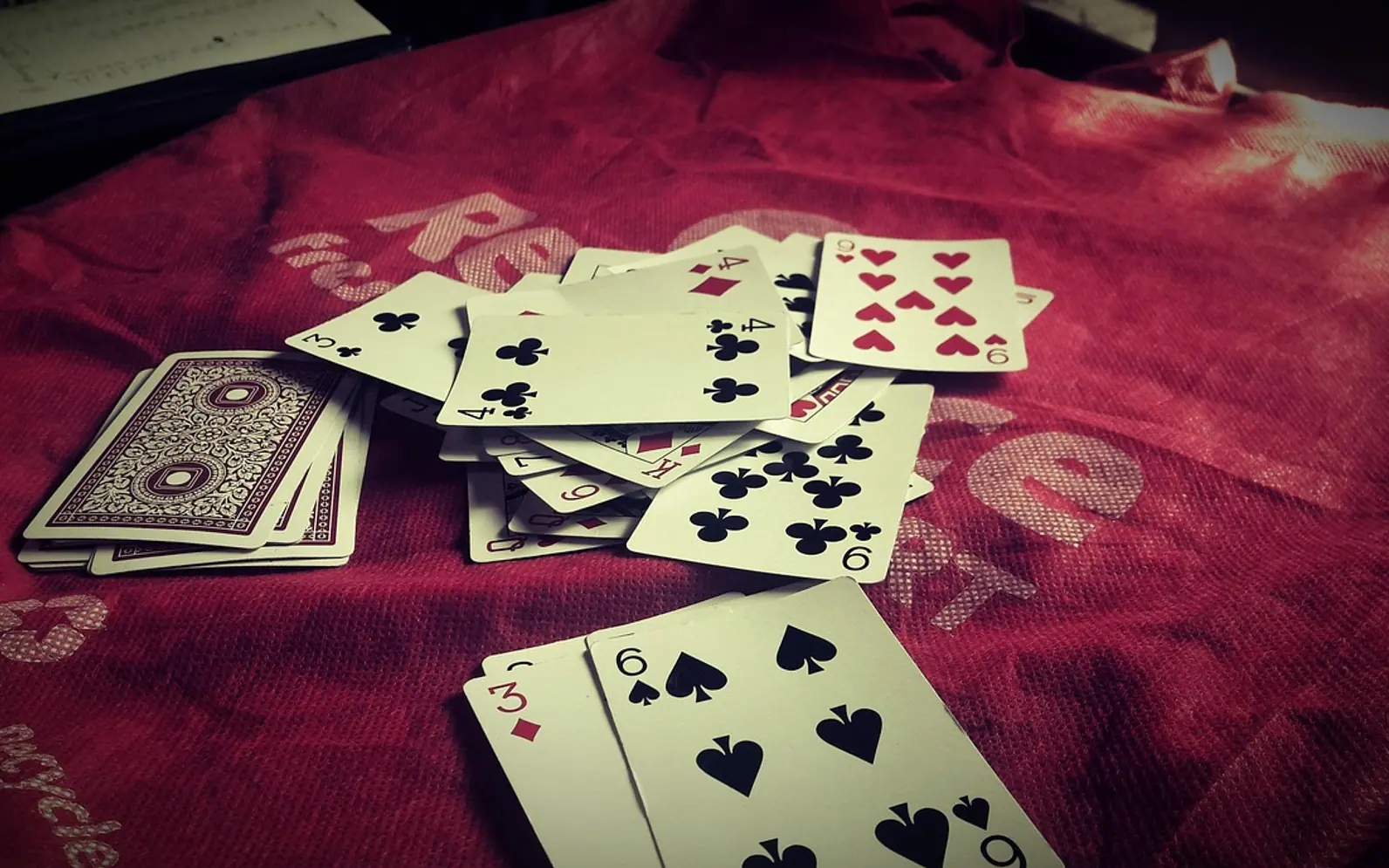
The chance of drawing a particular kind of card is the number of cards that fit, divided by the number of cards still in the pack. From a full, shuffled 52-card deck, an ace turns up with probability 4/52, a heart with 13/52 and a red card with 26/52. Once cards start leaving the deck, both halves of that fraction change, and that is where card probability gets interesting.
What is inside a standard deck
Every calculation starts from the same inventory, so it helps to have it in one place.
| Group | Cards in a 52-card deck | Chance on one draw |
|---|---|---|
| One exact card (say the queen of clubs) | 1 | 1/52, about 1.9% |
| One rank (all four aces) | 4 | 1/13, about 7.7% |
| Picture cards (jacks, queens, kings) | 12 | 3/13, about 23.1% |
| One suit (all hearts) | 13 | 1/4, 25% |
| Ten-value cards in blackjack (tens and pictures) | 16 | 4/13, about 30.8% |
| One colour (all red cards) | 26 | 1/2, 50% |
Four rules that cover most questions
1. Single draws: count and divide
Favourable cards over total cards. A one-card question needs nothing more.
2. "Not": use the complement
The chance that something does not happen is one minus the chance that it does. Missing an ace on one draw is 48/52, which is 12/13.
3. "Or": add, then remove the overlap
An ace or a king covers 4 + 4 = 8 cards, so 8/52. When groups overlap, subtract the shared cards so nothing is counted twice. A heart or a picture card covers 13 + 12 − 3 = 22 cards, because the jack, queen and king of hearts belong to both groups. That gives 22/52, roughly 42%.
4. "And": multiply, updating as you go
For two events in a row, multiply the first chance by the second, where the second is worked out from the deck as it stands after the first draw. Two aces off the top: 4/52 × 3/51 = 12/2,652, which reduces to 1/221.
With and without replacement
Most card games deal without replacement: a card that has been dealt stays out of the pack. That is the big difference between cards on one side and dice or a roulette wheel on the other. If the first card were shuffled back in before the second draw, two aces would come up 1/13 × 1/13 = 1/169 of the time. Because it is not, the true figure is the smaller 1/221.
The effect can work for you as well as against you. Say you can see five cards and none of them is an ace. All four aces are hiding among the 47 cards you have not seen, so the chance that the next card is an ace rises from 4/52 to 4/47, about 8.5%. Knowing which cards are gone always changes the count, which is why poker players pay attention to everything face up. Our guide to Omaha poker rules shows how much there is to keep track of when every player holds four cards.
At least one ace in a five-card hand
Suppose five cards are dealt and you want the chance of at least one ace. Listing every hand with one, two, three or four aces is slow. The quicker route uses the complement again: count the five-card hands with no ace and compare them with all possible hands.
- All five-card hands: choosing 5 from 52 gives 2,598,960.
- Hands with no ace: choosing 5 from the 48 non-aces gives 1,712,304.
- No ace therefore turns up about 65.9% of the time.
- At least one ace takes the remainder, roughly 34.1%.
Those "choosing" numbers are combinations, the counting tool behind almost every poker figure. The article on poker combinatorics shows how to work them out by hand.
One deck or eight: why shoes behave differently
Baccarat, Dragon Tiger and many live blackjack tables deal from a shoe holding several decks. The more decks, the less each removed card shifts the odds. With one deck, an ace on the first card leaves 3 aces in 51 cards for the second, about 5.9%. With six decks there are 24 aces in 312 cards; after one ace is dealt, 23 remain in 311, about 7.4%, barely below the starting 7.7%. That is one reason shoe games feel close to independent draws, and why the result boards described in our Dragon Tiger guide say so little about the next card.
Mix-ups to avoid
- Probability versus odds. A 1 in 13 chance is 12 to 1 against, not 13 to 1.
- Double counting. Overlapping groups, such as hearts and picture cards, need the shared cards removed once.
- Forgetting the cards you can see. Your own hand and any face-up cards are no longer in the deck.
- Using single-deck figures at a shoe table. Check how many decks are in play before trusting a number.
Blackjack is where these rules earn their keep, and our follow-up on blackjack probability applies them to naturals and bust chances.
All of this is arithmetic for curious adults, not a system for beating a table. Card games played for money are 18+ only, every dealt hand carries a house margin somewhere, and the rules on online card games differ from place to place, so look up yours before you sit down.